Why does cyber risk management matter?
Cyber security risks affect far more than IT systems. When they materialize, they disrupt operations, drain budgets, and put customer trust under pressure. Managing those risks in a structured way helps organizations stay in control as threats continue to change.
The impact of unmanaged risk
When risks remain unidentified or poorly understood, organizations often feel the consequences across several areas.
Financial exposure
Security incidents lead to recovery costs, legal fees, regulatory fines, and lost revenue. These expenses rarely stay isolated to one team or department.
Operational disruption
System outages and restricted access slow down daily work. In many cases, teams need to pause critical processes while they investigate and recover.
Reputational damage
Customers and partners expect reliable handling of data. A single incident can weaken confidence and affect long-term relationships.
Regulatory consequences
Many regulations require organizations to demonstrate active risk oversight. Gaps in documentation or controls can lead to penalties and increased scrutiny.
These outcomes often build on each other. Addressing risk early helps reduce escalation and limits long-term impact.
From reactive response to proactive prevention
Structured cyber risk management supports a deliberate approach to security. Teams identify likely problem areas and plan suitable responses in advance.
This approach supports:
-
More predictable security planning
-
Clearer communication with leadership
-
Stronger justification for security investments
It also improves day-to-day decision-making. When teams understand their highest risks, they can evaluate changes more confidently. For example, launching a new tool, onboarding a supplier, or changing access rights becomes a conscious trade-off instead of an implicit risk.
Over time, this clarity supports better budget discussions. Security investments link back to specific risks, which helps leadership understand why certain controls take priority. As a result, security decisions become easier to explain and easier to defend during audits or reviews.
Alignment with established standards
Risk management sits at the center of many widely adopted frameworks.
ISO 27001 requires organizations to base their Information Security Management System on documented risk assessment and treatment activities. NIS2 introduces governance expectations that include ongoing risk awareness and accountability. TISAX® applies similar principles in the automotive context, with a strong focus on supplier relationships.
Treating risk management as a continuous process supports alignment across these standards without unnecessary duplication.
The cyber risk management lifecycle
Cyber security risk management works best as a repeating, practical cycle. Each step builds on the previous one and feeds into the next.
Identify: common cyber security risks
The identification phase focuses on understanding which risks could realistically affect the organization. This step works best when teams look beyond technology alone and consider people, processes, and external dependencies.
Building a complete view of exposure
Risk identification often starts with asset visibility. Teams review systems, data types, business processes, and integrations to understand where exposure exists. Workshops, interviews, and technical assessments all contribute useful input.
To keep this work practical, many teams start with a short set of prompts:
-
Which systems store or process sensitive data
-
Which services support revenue, delivery, or customer access
-
Which teams rely on shared platforms or core infrastructure
From there, it helps to document where data moves. For example, a customer support tool might connect to your CRM, which then syncs into analytics. That chain matters during incident response and during risk treatment planning.
Supplier exposure also belongs here. If a vendor hosts critical services, processes personal data, or maintains privileged access, teams should maintain structured records on these details. This step reduces blind spots and makes later assessments easier to defend.
Common risk categories
Technical risks
These include malware infections, ransomware attacks, denial-of-service activity, and insecure system configurations. Cloud environments and legacy systems often require particular attention.
Human-related risks
Phishing attempts, weak authentication practices, and accidental data exposure fall into this category. Training gaps and unclear responsibilities increase likelihood over time.
Organizational risks
Missing policies, outdated procedures, and incomplete asset inventories reduce consistency. Suppliers without defined security expectations also add uncertainty.
External risks
Regulatory change, geopolitical developments, and vulnerabilities in widely used software can affect exposure even without internal changes.
Rather than ignoring these factors, teams should take reasonable steps to evaluate how much they can affect business assets. That connection supports meaningful assessment later in the process, where teams can align on business continuity plans that keep critical operations running.
Assess: prioritizing risks by likelihood and impact
Assessments determine which risks need immediate attention and which ones require ongoing monitoring.
Most organizations assess risk by combining likelihood and impact. Likelihood capture how likely it is for the risk to materialize based on current threats and existing controls. Impact reflects potential disruption to operations, finances, or reputation.
Using a risk matrix
A risk matrix translates assessments into a visual format. It groups risks into categories that help teams focus effort where it matters most.
Many organizations score risk on a simple scale, then calculate a rating based on those inputs. A typical approach assigns a likelihood score and an impact score, then combines them into an overall rating.
It also helps to separate inherent risk from residual risk. Inherent risk describes exposure before controls have been applied. Residual risk reflects the remaining exposure after controls have been put in place. This distinction supports better decisions, since it shows whether existing measures already reduce the risk to an acceptable level.
When teams use a consistent model, they can compare risks across departments and across time. That consistency also supports leadership discussions, since the rating logic stays stable even if individual risks change.
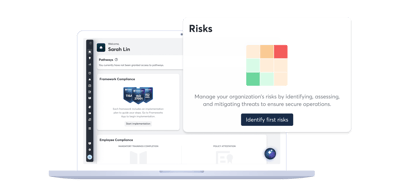
Many organizations support this consistency with a centralized risk management system. Instead of tracking risks in disconnected spreadsheets, teams work from a shared risk register with defined scoring criteria and ownership.
DataGuard supports this approach by providing a structured risk register, configurable scoring models, and clear links between risks, controls, and reviews. This helps teams apply the same logic across departments, track changes over time, and surface meaningful insights for leadership discussions without reworking assessments each cycle.
As risks evolve, updates stay visible and traceable. That makes it easier to understand trends, explain decisions, and keep the risk conversation grounded in shared data.
Factors that influence scoring
Risk scores often consider:
- Asset sensitivity and data classification
- Dependency on the affected system or process
- Known attack trends in the relevant industry
To avoid subjective interpretations of different kinds of risks, teams should align on a defined list of criteria that defines final scores during risk assessments.
Maintaining assessment records
Documented assessments support accountability. A maintained risk register records ownership, rationale, and planned actions, which simplifies reviews and audits.
To keep documentation useful, aim for decision-ready detail. That usually includes:
- A short description of the scenario and affected assets
- The likelihood and impact scores, plus the rationale behind them
- The current controls that reduce exposure
- The risk owner and a target review date
If you work in a regulated environment, document who approved the rating and treatment decisions. This creates a clear trail when auditors ask how the organization reached a conclusion.
When risks change, update the record instead of creating a new entry. That preserves the history of decisions and makes progress easier to track.
Treat: how to mitigate and manage cyber risks
Risk treatment turns analysis into action. At this stage, organizations decide how they want to handle each prioritized risk.
Treatment strategies in practice
Mitigation
Organizations reduce risk by implementing controls such as access restrictions, encryption, monitoring, or process changes.
Transfer
Some risk shifts through insurance or contractual agreements with suppliers and service providers.
Acceptance
Low-impact risks may be accepted with clear documentation and defined review points.
Avoidance
Organizations remove exposure by retiring systems, changing workflows, or discontinuing risky activities.
Each decision should reflect business priorities and proportionality.
Selecting and implementing controls
Frameworks like ISO 27001 offer structured guidance for control selection. NIS2 obligations also influence decisions, particularly in incident handling and supplier management.
Control selection works best when teams start with the risk scenario, then choose measures that directly reduce likelihood or impact. For example, a phishing-related risk often improves with stronger authentication, better detection, and clearer verification steps for high-impact actions.
Implementation also needs ownership. A control may look good on paper, yet fail in practice if teams lack time, clarity, or tooling. Assign an owner, define how success looks, and set a check-in cadence.
Evidence matters too. Controls that support audits should produce a trail, such as configuration screenshots, system reports, or training records. This reduces last-minute scrambling when reviews come up.
Reinforcing treatment through training
Policies and controls rely on consistent behavior. Ongoing awareness activities and role-specific training help teams apply controls correctly during daily work.
Monitor and review: keeping risk management up to date
Risk management continues after initial risk treatment. Monitoring and reviews keep the process aligned with real-world conditions.
Continuous oversight
Organizations benefit from regular reviews that confirm controls still work as intended. Internal audits, testing, and performance metrics support this oversight.
Many teams align reviews with a simple management cadence. High-risk areas receive more frequent attention, while lower-risk items follow a lighter schedule. This approach keeps effort proportional and avoids review fatigue.
Management review and escalation
Management reviews focus on trends rather than individual findings. Leaders typically look at changes in overall exposure, progress on treatment plans, and emerging risks that may affect strategy.
When risks exceed agreed thresholds, teams should escalate them with clear context. That context usually includes potential impact, current controls, and available options. This supports timely decisions without pulling leadership into unnecessary detail.
Adapting to change
Significant changes should trigger reassessment. Examples include new technologies, acquisitions, supplier changes, or security incidents. Updating the risk register keeps decisions relevant.
Measuring progress
Metrics such as incident frequency, detection timelines, and training participation support informed management discussions and continual improvement.
How does risk management connect to compliance frameworks?
A consistent risk management approach supports both security outcomes and regulatory expectations.
ISO 27001
ISO 27001 requires documented risk identification, assessment, and treatment as part of building an ISMS. Auditors expect clear links between identified risks, selected controls, and ongoing reviews.
NIS2
NIS2 emphasizes leadership accountability, supply-chain awareness, and incident readiness. Structured risk management helps organizations demonstrate oversight and decision-making at the management level.
TISAX®
TISAX® assessments rely on risk-based thinking aligned with ISO 27001 principles. Mature risk processes support consistent results across automotive supply chains.
One system, multiple obligations
Using a single risk management process reduces duplication across teams and reviews. It also creates consistency across audits, internal reporting, and regulatory reviews, which saves time and effort over the long term.
To get that benefit, teams usually need a clear mapping between risks, controls, and requirements. For example:
- The risk register explains what the organization prioritizes
- Treatment plans show which controls address which risks
- Evidence logs show that controls operate as intended
This structure supports multiple audiences. Security teams can track progress. Leadership can review exposure trends. Auditors can verify that decisions follow a documented process.
If you operate across regions or industries, this approach also reduces rework. You keep one core risk method and adapt reporting outputs for each framework.
Put your risk management process into practice with DataGuard
See how DataGuard helps teams centralize risk assessments, maintain consistent scoring, and adapt reporting across frameworks without duplicating work.




_EasiestSetup_EaseOfSetup.svg)